Certifications & Compliance

Standards & Compliance Reference

Every certification we carry, explained — from EN ISO 11612 flame protection to IEC 61482 arc flash, high-visibility, chemical splash and beyond.

Universal Markets Company sources and supplies PPE and workwear that meets the most demanding international certification programmes. The standards below govern the performance of the products we carry and are recognised by leading industrial operators across Saudi Arabia — from Saudi Aramco and SABIC to EPC contractors and government utilities.

International Standards

EN ISO 11612

Protective Clothing Against Heat and Flame

FlameHeatFR Clothing

EN ISO 11612 is the European benchmark for protective garments worn in environments with risk of flame, convective heat, radiant heat, and molten metal splashes. Garments are evaluated across six performance indices — A (flame spread), B (convective heat), C (radiant heat), D (molten aluminium), E (molten iron), and F (contact heat) — with numerical ratings indicating protection levels. It is the most commonly specified FR clothing standard by Saudi Aramco, SABIC, and their contractors.

View Products

EN ISO 11611

Protective Clothing for Welding and Allied Processes

FlameWeldingHeat

EN ISO 11611 defines requirements for protective clothing used during arc welding, plasma cutting, oxygen cutting, and allied thermal processes. Class 1 covers welding techniques with minimal spatter and UV radiation, while Class 2 addresses high-spatter, high-UV operations. Garments must self-extinguish after flame exposure and provide electrical insulation at low voltages.

View Products
NFPA 2112

Flame-Resistant Garments for Industrial Workers

FlameFlash FireFR Clothing

NFPA 2112 is the North American standard governing flame-resistant garments for workers exposed to flash fire hazards in industrial settings. It specifies requirements for fabric heat transfer performance, thermal shrinkage, and overall garment construction. Compliance is required by major oil & gas operators under NFPA 2113 — the standard for selection, care, and use of FR garments.

View Products

NFPA 70E

Electrical Safety in the Workplace

Arc FlashElectricalHigh Voltage

NFPA 70E establishes safe electrical work practices and PPE requirements to protect personnel from arc flash and arc blast hazards. It defines four Protection Boundaries and assigns PPE to Arc Flash Protection Categories based on incident energy levels in cal/cm². It is the core reference for electrical maintenance safety programmes at industrial facilities worldwide.

View Products

IEC 61482-2

Protective Clothing Against Electric Arc Thermal Hazards

Arc FlashElectricalHigh Voltage

IEC 61482-2 specifies requirements for protective clothing guarding against the thermal hazards of electric arcs. Garments are tested using the open-arc method (ATPV or EBT rating in cal/cm²) or the box-test method (Arc Protection Class 1 or 2). The standard is widely used in Europe and the Gulf for high-voltage electrical maintenance PPE procurement.

View Products

EN 1149-5

Electrostatic Properties — Garment Performance Requirements

ElectrostaticATEXChemical

EN 1149-5 is Part 5 of the EN 1149 series, defining garment-level design requirements for use in potentially explosive atmospheres. Unlike Parts 1 and 3, which test individual fabric properties, Part 5 evaluates the complete garment as a system — including seams, closures, and attachments. It is the part cited in ATEX workplace regulations for electrostatic protective workwear.

View Products

EN ISO 20471

High-Visibility Clothing

Hi-VisTrafficLow-Light

EN ISO 20471 specifies requirements for clothing that makes workers conspicuous under any light conditions, including at night when illuminated by vehicle headlights. Three classes define minimum areas of fluorescent background material and retroreflective tape. Class 3 provides the highest coverage and is required for road workers, airport ground crews, and railway maintenance personnel.

View Products

EN 388

Protective Gloves Against Mechanical Risks

CutAbrasionGloves

EN 388 defines performance requirements for gloves offering protection against abrasion, blade cut, tear resistance, and puncture. The 2016 revision introduced the ISO 13997 TDM-cut test (rated A–F) and an optional impact protection designation. Each glove carries a four-character performance code — the higher the digit, the greater the protection level for that specific mechanical hazard.

View Products
EN ISO 13034

Protective Clothing Against Liquid Chemical Splash

ChemicalSplashLimited Performance

EN ISO 13034 covers Type 6 and Type PB [6] protective clothing offering limited protection against liquid chemical splashes. Type 6 full garments are tested against fine mist and spray; Type PB [6] covers specific body areas only. Suited to low-concentration chemical handling, laboratory work, and maintenance activities where splash — not immersion — is the primary risk.

View Products
EN 343

Protective Clothing Against Rain and Wet Weather

RainWeatherWaterproof

EN 343 sets requirements for garments protecting against rain, fog, and ground moisture. Performance is rated 1–3 for both water penetration resistance and water vapour transmission (breathability). A rating of 3/3 indicates the highest combined protection — keeping workers dry while allowing sweat vapour to escape, which is critical for sustained outdoor activity in humid or wet conditions.

View Products
EN ISO 16321-1

Eye and Face Protection for Occupational Use — General Requirements

Eye ProtectionFace ProtectionEU Compliance

EN ISO 16321-1 is the modern harmonised international standard for eye and face protectors in occupational environments, progressively superseding EN 166:2001 as the primary European and ISO reference. Part 1 establishes general requirements for design, construction, optical performance, and marking of safety spectacles, goggles, face shields, and welding protectors. It introduces an updated classification framework with revised test methods for mechanical, optical, and radiation hazard resistance.

View Products
EN 166:2001

Personal Eye Protection — Optical Safety Eyewear

Eye ProtectionEU Compliance

EN 166:2001 is the European standard specifying requirements for all types of personal eye protectors used in occupational settings. It covers optical properties, mechanical resistance, and protection against fine particles, liquid droplets, large dust particles, high-speed particles, and optical radiation. Products conforming to EN 166 bear the CE mark alongside pictograms indicating their specific protection level — making it the baseline specification for safety glasses, goggles, and face shields procured across KSA industrial sites.

View Products
EN 172:1994

Personal Eye Protection — Sun Glare Filters for Industrial Use

Eye ProtectionUVOutdoor

EN 172:1994 specifies requirements for sun glare filters designed for industrial occupational use where workers are exposed to excessive solar radiation. Scale numbers 1.1 to 4.1 indicate the luminous transmittance of the filter — the higher the number, the darker the lens. Used by construction workers, road crews, and outdoor industrial personnel to prevent eye fatigue, temporary blindness, and long-term UV damage in high-sun environments such as Saudi Arabia.

View Products
EN 170:2002

Personal Eye Protection — Ultraviolet Filters

Eye ProtectionUVEU Compliance

EN 170:2002 specifies transmittance requirements for ultraviolet filters used in personal eye protectors for occupational use. UV filters are graded by scale numbers corresponding to their UV transmittance — critical for welding operations, UV lamp maintenance, and outdoor environments with elevated radiation levels. The standard ensures filters block sufficient UV energy while maintaining enough visible light transmittance for safe working conditions.

View Products
ANSI Z89.1

American Standard for Industrial Head Protection

Head ProtectionImpactUS Standard

ANSI/ISEA Z89.1 is the American National Standard establishing performance and testing requirements for industrial head protection. It defines Type I (top-impact protection) and Type II (top and lateral impact protection), and three electrical classes: Class E (Electrical, rated to 20,000V), Class G (General, rated to 2,200V), and Class C (Conductive, no electrical protection). Widely specified for US multinational operations and North American-aligned EPC projects in the Kingdom.

View Products
CSA Z94.1

Canadian Standard for Industrial Protective Headwear

Head ProtectionImpact

CSA Z94.1 is the Canadian Standards Association standard for industrial protective headwear. It classifies helmets by type (protection zone) and class (electrical resistance), with an additional Class P designation for helmets with a peak (brim). CSA Z94.1-certified helmets are required on Canadian construction and industrial sites and are increasingly specified by multinational project operators and EPC contractors with Canadian affiliations working in Saudi Arabia.

View Products

Protection Levels & Marks

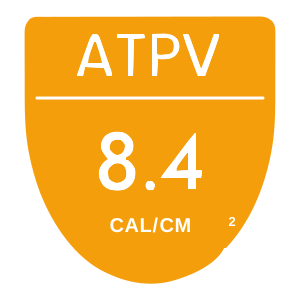
ATPV 8.4 CAL/CM²

Arc Thermal Performance Value — 8.4 cal/cm²

Arc FlashATPVElectrical

ATPV (Arc Thermal Performance Value) is the incident energy level at which there is a 50% probability that exposed bare skin will receive a second-degree burn, measured in cal/cm² per ASTM F1959. A rating of 8.4 cal/cm² exceeds the NFPA 70E Category 2 minimum of 8 cal/cm², providing a safety margin for 480V electrical maintenance tasks including voltage testing, meter reading, and minor switchgear operations.

View Products
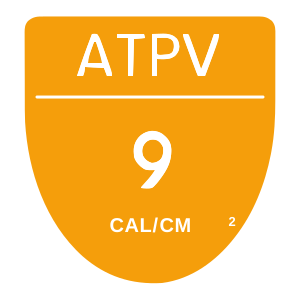
ATPV 9 CAL/CM²

Arc Thermal Performance Value — 9 cal/cm²

Arc FlashATPVElectrical

A 9 cal/cm² ATPV rating is common in everyday FR workwear designed for industrial environments with routine electrical exposure. It exceeds the NFPA 70E Category 2 minimum of 8 cal/cm², making it a prevalent specification for general maintenance personnel, instrument technicians, and production operators who work near energised electrical equipment regularly.

View Products
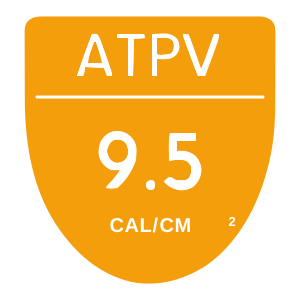
ATPV 9.5 CAL/CM²

Arc Thermal Performance Value — 9.5 cal/cm²

Arc FlashATPVElectrical

An ATPV of 9.5 cal/cm² is a widely specified rating for FR coveralls and two-piece FR garments used across oil & gas, petrochemical, and utility sectors. Comfortably within the Category 2 zone of NFPA 70E, it provides adequate daily-wear arc flash protection for plant operators and maintenance crews working near 480V and medium-voltage systems.

View Products
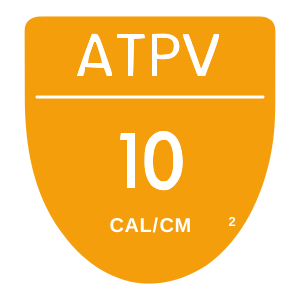
ATPV 10 CAL/CM²

Arc Thermal Performance Value — 10 cal/cm²

Arc FlashATPVElectrical

A rating of 10 cal/cm² provides protection adequate for moderate arc flash exposures as defined under NFPA 70E Category 2 scenarios — typical of 480V switchgear and distribution panel tasks. It is one of the most commonly specified ATPV values for FR coveralls and shirts worn by electrical maintenance and operations personnel in industrial facilities.

View Products
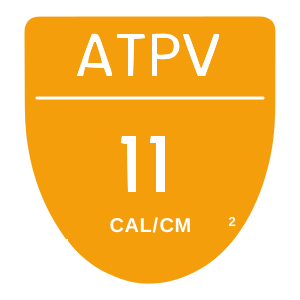
ATPV 11 CAL/CM²

Arc Thermal Performance Value — 11 cal/cm²

Arc FlashATPVElectrical

An ATPV of 11 cal/cm² provides additional headroom above the Category 2 minimum, making it a preferred specification for FR garments used in environments where incident energy calculations vary or where a conservative approach to PPE selection is mandated by site safety programmes. Often applied to FR coveralls in petrochemical facilities and utilities operating 600V-class systems.

View Products
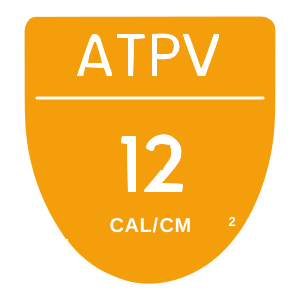
ATPV 12 CAL/CM²

Arc Thermal Performance Value — 12 cal/cm²

Arc FlashATPVElectrical

A 12 cal/cm² ATPV rating is commonly found in heavier-weight FR fabrics and multi-layer garment systems. Exceeding the Category 2 threshold by 50%, it offers meaningful protection margin for electrical maintenance in 480V–600V switchgear, motor control centres, and process plant instrumentation panels where fault current levels may produce moderate arc energies.

View Products
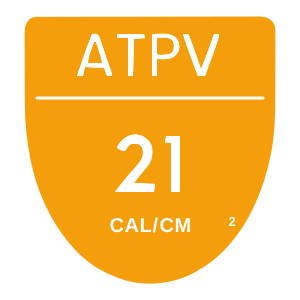
ATPV 21 CAL/CM²

Arc Thermal Performance Value — 21 cal/cm²

Arc FlashATPVHigh Voltage

A 21 cal/cm² ATPV places garments in the upper Category 2 / lower Category 3 range. Typically achieved by multi-layer FR systems — an inner moisture-wicking base layer combined with an arc-rated outer garment — this level is required for higher-energy switching tasks, medium-voltage work (4–15kV class), and operations where incident energy exceeds standard Category 2 limits.

View Products
ATPV 50 CAL/CM²

Arc Thermal Performance Value — 50 cal/cm²

Arc FlashATPVHigh Voltage

An ATPV of 50 cal/cm² represents extreme arc flash protection — well above the NFPA 70E Category 4 minimum of 40 cal/cm². Achieved by full arc flash suits and heavy multi-layer FR systems, this rating is mandatory for high-energy electrical switching at utility substations, high-voltage transmission equipment, and industrial facilities with very high available fault currents.

View Products
CAT 2

Arc Flash Protection Category 2

Arc FlashNFPA 70EElectrical

NFPA 70E Arc Flash Protection Category 2 requires a minimum arc rating of 8 cal/cm². Tasks in this category include work on 480V switchgear with doors open, voltage testing on low-voltage panels, and similar activities where calculated incident energy falls between 4 and 25 cal/cm². Typical PPE includes an arc-rated FR shirt, trousers or coverall, face shield, and insulated rubber gloves.

View Products
CAT 4

Arc Flash Protection Category 4

Arc FlashNFPA 70EHigh Voltage

NFPA 70E Arc Flash Protection Category 4 requires a minimum arc rating of 40 cal/cm² — the highest standard PPE level. It applies to high-energy switching operations and equipment with large available fault currents. A full arc flash suit, arc-rated hood and face shield, double-layer FR clothing, and heavy-duty leather gloves over insulated rubber gloves are typically required.

View Products
HRC 2

Hazard Risk Category 2 (Legacy NFPA 70E)

Arc FlashLegacyElectrical

HRC 2 (Hazard Risk Category 2) was the designation used in NFPA 70E editions prior to 2012 for arc flash scenarios requiring a minimum arc rating of 8 cal/cm². The HRC classification was replaced by the current Arc Flash Protection Category (CAT) system to eliminate confusion. Products marked HRC 2 remain in circulation and are equivalent in protection to current CAT 2 requirements.

View Products
HRC 3

Hazard Risk Category 3 (Legacy NFPA 70E)

Arc FlashLegacyElectrical

HRC 3 designated arc flash scenarios requiring a minimum garment arc rating of 25 cal/cm² under the pre-2012 NFPA 70E system. Replaced by the CAT classification in 2012, HRC 3 marked garments remain widely available and correspond to protection requirements between CAT 2 and CAT 4. Always verify the specific ATPV or EBT value printed on the garment label.

View Products
HRC 4

Hazard Risk Category 4 (Legacy NFPA 70E)

Arc FlashLegacyHigh Voltage

HRC 4 was the highest category under the pre-2012 NFPA 70E classification, requiring a minimum arc rating of 40 cal/cm². It corresponds directly to the current CAT 4 designation. HRC 4 garments — typically full arc flash suits — continue to be used in high-voltage electrical maintenance and utility switching operations requiring maximum arc flash protection.

View Products
CE

CE Conformity Mark

EU ComplianceRegulatoryPPE Regulation

The CE mark declares that a product conforms to relevant European Union safety, health, and environmental requirements under applicable EU directives — including the PPE Regulation (EU) 2016/425. It is a mandatory legal declaration, not a quality endorsement. Category II and III PPE undergoes independent third-party assessment by a Notified Body before the CE mark may be applied.

View Products
UL

UL Listed — Underwriters Laboratories

US StandardListingSafety

The UL mark signifies that a product has been independently tested and certified by UL Solutions to applicable American National Standards. For workwear and PPE, UL certification is particularly relevant for arc-rated garments, electrical safety products, and equipment destined for North American markets or US-based multinational operations in the Kingdom.

View Products

Ready to Equip Your Team?

Connect with our team for bulk pricing, certified PPE sourcing, and fast delivery across Saudi Arabia.

  • Response within 24 hours
  • Dedicated account manager
  • Bulk pricing & volume discounts
  • Custom alterations on request